
Adolf Kofi Awua came to public health through an unconventional path. "As a biochemist in Ghana I was focused on the development of protocols for the molecular identification of the Human Papillomavirus (HPV), which causes cervical cancer,” he said. “However, the samples collected in the field by public health professionals weren’t meeting the necessary quality criteria to do lab workups. I felt the need to understand what the issues were in sample collection; that drew me out of the lab and into the field with the epidemiologists."
Adolf enjoyed working with them so much that he earned a doctorate in epidemiology from the University of Ghana, continuing to focus on the molecular epidemiology of HPV for his dissertation. However, as he became more involved with fieldwork, he discovered that talking to study participants required considerable nuance. "My research entailed asking participants about risk factors that can be sensitive and personal, like their sexual history," he explained. "I realized I wasn’t dealing with a research subject—I was dealing with a person. Interacting with people from different backgrounds and different understandings of what you're doing obligates you to make them feel safe and comfortable. I started asking, 'How can I better care for and protect my participants?' And that led to my interest in bioethics."
In conjunction with the NYU-UG Research Integrity Training Program, which is a fellowship run jointly by NYU and the University of Ghana, Adolf began working toward his MA in Bioethics from GPH, graduating from the program in 2022. Studying completely online due to Covid-19 travel restrictions, Adolf appreciated the wide-ranging discussions and joint assignments within study groups—both formal and casual—that allowed him to interact with classmates.
He credits a course on non-consequentialism with a significant reorientation of his approach to his work, balancing his customary regulatory framework with a philosophical one. “Philosophy empowers you to question the regulation, consider its context and understand its intention, so that when you apply the rules you’re not just ticking a box. It’s not the completed form that makes it ethical; it’s meeting the intention,” Adolf explained. “No other training program taught me that, and it serves me well now.” He also appreciated a course on moral intuition, which people employ without even noticing, and his “third most memorable course” was environmental ethics, whose principles he applied to his work on nuclear-based methods of microbial detection at the Ghana Atomic Energy Commission.
The interdisciplinary aspect of the GPH Bioethics degree enabled Adolf to suffuse his work as a biochemist, epidemiologist and nuclear science researcher with ethical perspectives. For his master’s thesis, he put his scientific background to good use by analyzing quality control testing during disease outbreaks. “In the midst of Covid-19 in Ghana, limited resources did not allow quality control to be performed for some testing labs, so I tried to develop an ethical framework for questioning resource allocation due to an infectious agent-based epidemic. Should we use some testing resources to do quality control, or should we put all the resources toward testing the population without quality control, risking a greater number of false results? It was really interesting to reflect on how to balance these considerations.”
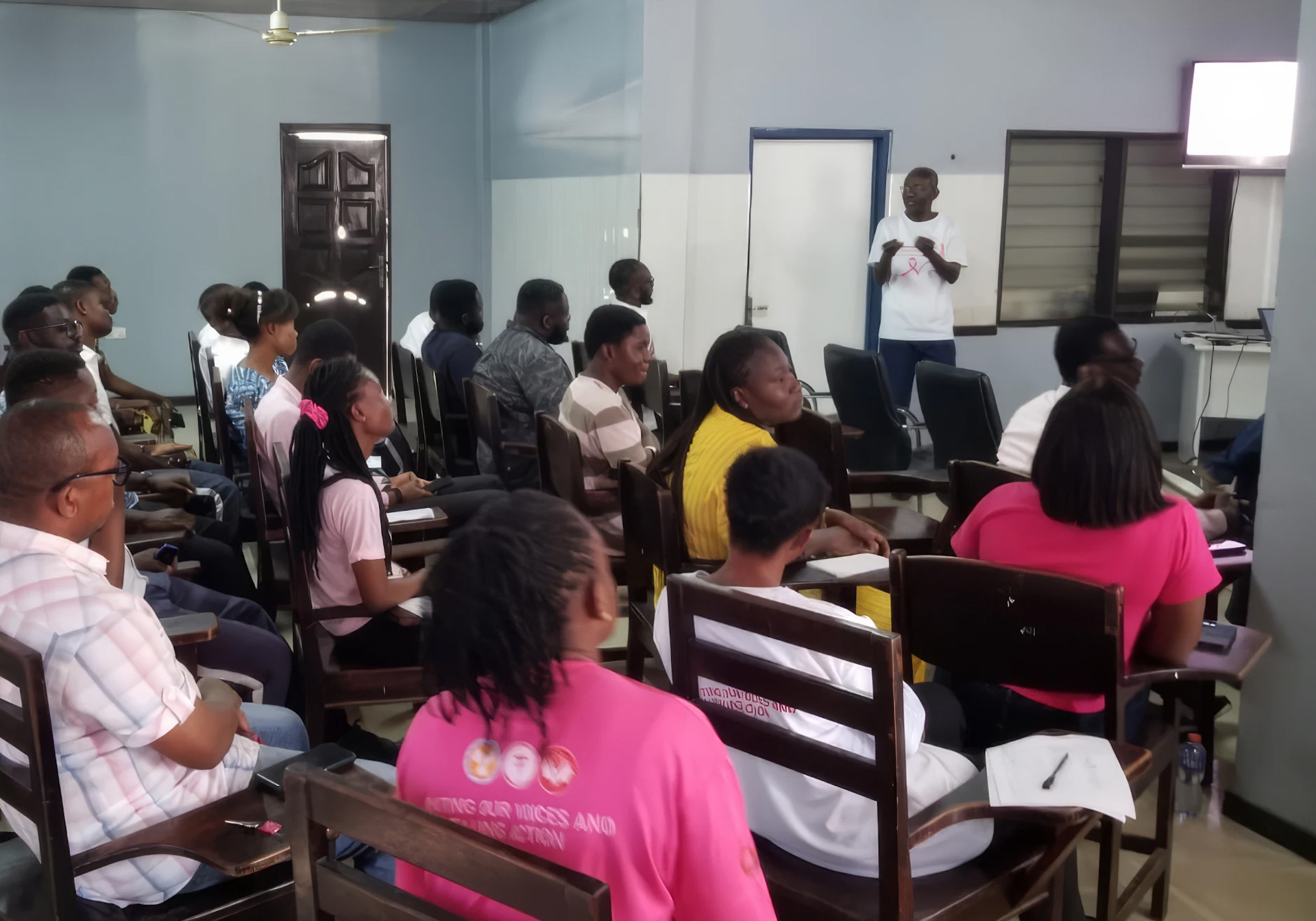
Since completing his MA in bioethics, Adolf has integrated his scientific background with his enthusiasm for philosophy, both as a researcher and as an educator. “For my nuclear energy research, I’m looking at nuclear power plants’ development from an environmental ethics perspective, considering how to balance the potential environmental costs and benefits. As an epidemiologist, I’ve been working to incorporate ethics into educational materials for cancer prevention. I’ve been reading more about bioethics in the African context, considering how to overcome power differences and gender differences that may exist, and how to engage communities in ways that can overcome those differences.”
Adolf has been teaching for the University of Ghana's recently-established MSc program in bioethics at its School of Public Health, and Research Methods (including Research Ethics) at the School of Nuclear and Allied Science. He also teaches in the Gambian Research Methodology and Ethics program, and mentored students in the African Bioethics Network Fellowship Program. As an educator, Adolf reflects on making ethics training for researchers more philosophically-oriented. "As a core member of a very new bioethics program, I see an opportunity to approach training differently. I believe we should start with the philosophical aspects before discussing the development of regulations, so that we can actually compose things according to our own unique context and conditions. Then we can modify regulations adopted from around the world, so they work for us in our present and our future."